*Sudan, Sovereignty, and the Internationalization of War: An Interview with Ambassador Muawiya Al-Bukhari*
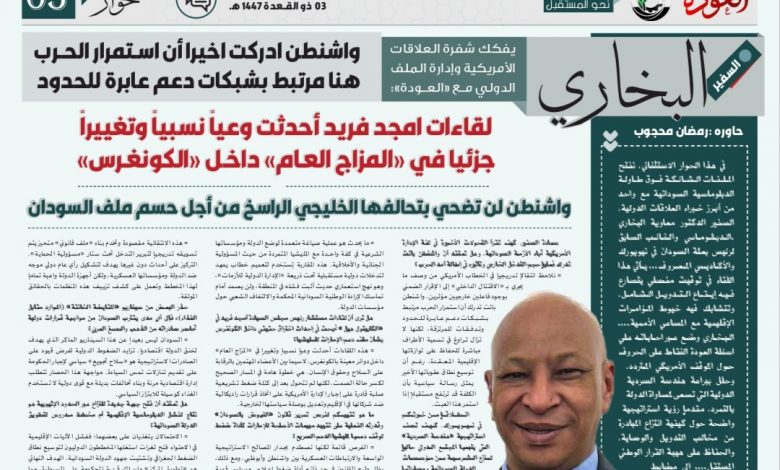
*Sudan, Sovereignty, and the Internationalization of War: An Interview with Ambassador Muawiya Al-Bukhari*
*Interview by Ramadan Mahgoub*
*Translated from Arabic by Sabah Al-Makki*
*_Ambassador Dr. Muawiya Al-Bukhari, a diplomat, former deputy head of Sudan’s mission in New York, and a well-known academic, argues that as Sudan’s war becomes increasingly shaped by regional sponsorship, humanitarian politics, and international narratives, the central issue is no longer only one of territory or military balance. It also concerns legitimacy, sovereignty, and the authority to define the crisis within the international system._*
*Introduction*
Washington has begun, albeit belatedly, to recognize that the war in Sudan is not merely an internal conflict. It is also sustained by cross-border support networks and wider regional calculations. Yet recognition has not led to decisive action. Recent meetings in Washington led by Amjad Farid, political adviser to the chairman of Sudan’s Transitional Sovereignty Council, appear to have generated some awareness and a modest shift in mood within parts of Congress. Even so, United States (U.S.) policy remains constrained by entrenched Gulf partnerships and, above all, by the realities of the Washington-Abu Dhabi relationship.
In this interview, Ambassador Dr. Muawiya Al-Bukhari argues that placing the Sudanese Armed Forces (SAF) and the Rapid Support Forces (RSF) militia in the same moral and political frame is not an act of neutrality. In his view, it is part of a broader discourse that could facilitate future forms of international intervention. He discusses the Berlin conference as an effort to test alternative forms of political legitimacy. He warns that efforts to move humanitarian action beyond the framework of the state carry serious sovereign consequences. He also argues that Sudan’s response must rest not on rhetorical defensiveness, but on disciplined diplomacy, credible evidence, and strategic coherence. The struggle ahead, he suggests, will be shaped not only by events on the battlefield, but also by the contest over narrative, legality, and political authority.
*Washington and the External Dimension of the War*
*Q1. How do you read the recent shift in the American language on Sudan? Has Washington finally begun to recognize the extent of external involvement in prolonging the war?*
*Ambassador Al-Bukhari*
There has been a gradual but clear shift in American discourse. What was once described as an internal conflict is now increasingly understood as a war shaped by external actors. Washington appears more aware that the conflict is sustained by cross-border support networks, including mercenary flows and other forms of regional backing. Even so, it remains reluctant to identify those actors explicitly, largely because it seeks to preserve a delicate regional balance. The recent expansion of sanctions suggests that Washington is signaling that the political cost of sustaining this war may rise if such interference continues.
*Q2. Drawing on your experience in New York, how would you describe the international effort to shape a narrative that strips Sudanese state institutions of legitimacy and places them on the same footing as the RSF?*
*Ambassador Al-Bukhari:*
What we are seeing is a deliberate effort to place the Sudanese state and its legitimate institutions in the same frame as the RSF, whether in moral terms or legal ones. This is not merely a question of language. It is a political framing that normalizes a discourse favorable to future external intervention under the banner of international crisis management. The region has seen this logic before, and it has repeatedly failed. In the end, it will not withstand a coherent national will or the continued rallying of Sudanese society around the institutions of the state.
*Q3. Do you believe recent meetings on Capitol Hill led by Amjad Farid produced any meaningful breakthrough in Congress regarding the United Arab Emirates (UAE) ‘s support for the RSF?*
*Ambassador Al-Bukhari:*
Those meetings seem to have generated some awareness and a modest shift in mood within certain circles in Congress, especially among members concerned with arms oversight and human rights. That matters. Breaking the silence is an important first step. But it would be premature to call it a real breakthrough. So far, it has not developed into a legislative pressure bloc strong enough to compel the administration to take more far-reaching measures against regional partners or significantly recalibrate its foreign-policy priorities.
*Q4. How do you assess the prospects for legislation such as the Sudan Advancement Act, particularly its ability to constrain arms sales to the UAE as a means of pressuring it to end its support for the RSF?*
*Ambassador Al-Bukhari:*
The possibility remains open, but it runs into broad strategic interests and longstanding military ties between Washington and Abu Dhabi. Even so, the introduction of such legislation carries political weight. It raises the reputational cost of indirect military support and signals that accountability will remain a live issue in Washington. Such measures may not produce immediate policy change, but they can still alter calculations by increasing scrutiny and political risk.
*Q5. How does American diplomacy view the RSF’s use of starvation as a weapon of war? Could this issue become an entry point for calls for humanitarian tutelage or even no-fly zones?*
*Ambassador Al-Bukhari:*
The use of food as a weapon of war is taken very seriously in Washington. It carries strong moral and political weight. Historically, situations of this kind have often led to calls for humanitarian corridors, protected access arrangements, or even no-fly zones. In that sense, starvation can become more than a humanitarian issue. It can also become an entry point for externally imposed mechanisms. The difficulty, however, lies in implementation. Any such move would still require a very difficult degree of international consensus, especially in a Security Council shaped by deep polarization and competing interests among the major powers.
*Q6. Massad Boulos has spoken of Donald Trump’s desire to end the war quickly. If Trump were to return, would he have different tools than the current administration to pressure the regional actors backing the RSF?*
*Ambassador Al-Bukhari:*
If President Trump were to return, he would likely approach the Sudan file through high-level transactional arrangements and direct pressure, rather than the slower institutional process associated with the current administration. His approach would probably be more abrupt and less constrained by diplomatic protocol. That could include political trade-offs and direct economic pressure to compel regional allies to align with his preferred outcome. In that sense, his method would differ sharply from the long-horizon diplomacy that has characterized Washington’s handling of the crisis so far.
*Q7. Do you believe the current U.S. administration is prepared to place serious pressure on Abu Dhabi, or will strategic ties between Washington and the UAE continue to block any decisive move?*
*Ambassador Al-Bukhari:*
The relationship between Washington and Abu Dhabi remains a real constraint on any serious public confrontation. The U.S. may apply calibrated pressure behind closed doors to contain regional escalation. But it is unlikely to sacrifice a deeply rooted Gulf partnership to resolve the Sudan file. That is the central limitation. Current pressure, where it exists, is narrow and carefully managed. Its purpose is less to address the deeper causes of the crisis than to contain its wider consequences.
*Humanitarian Action, Sovereignty, and Parallel Legitimacy*
*Q8. How do you interpret international efforts to take the humanitarian file away from Sudanese national authorities and hand it over to cross-border or externally managed mechanisms? What are the sovereignty risks involved?*
*Ambassador Al-Bukhari:*
This development raises serious concerns. It risks portraying the state as institutionally incapable of managing core humanitarian responsibilities. Cross-border administration is not a neutral technical device. At its core, it means bypassing national sovereignty. What begins as an emergency arrangement can harden into a standing institutional reality. That weakens state authority and sets precedents beyond immediate humanitarian response. That is why Sudan insists that it must remain the principal gateway through which relief is organized and delivered to its population.
*Q9. Civilian actors participated in the Berlin conference while the Sudanese government was absent. Do you see that conference as an attempt to construct an alternative legitimacy or a parallel political body outside the framework of the state?*
*Ambassador Al-Bukhari:*
The Berlin conference was, in effect, an exploratory exercise in political alternatives outside the formal framework of the Sudanese state. It sought to test parallel structures and provide non-state actors with an international platform from which to negotiate over Sudan’s future. That trajectory carries serious implications. It broadens recognition for actors who do not derive their standing from sovereign institutions. It also encourages the perception that Sudan can be politically managed through substitute bodies rather than through the state itself. In my view, such efforts will ultimately run up against the reality of national consciousness and the enduring centrality of the state in any viable settlement.
*Q10. The envoy of the Intergovernmental Authority on Development (IGAD) described the Berlin conference process as an advanced step, while Sudan officially rejected its outcomes. How do you read that contradiction between regional endorsement and sovereign refusal?*
*Ambassador Al-Bukhari:*
What this reveals is a clear divergence of agendas. IGAD appears to be seeking a fast-moving negotiating track that preserves its regional role, even if that comes at the expense of Sudan’s sovereign interests. The regional endorsement of the Berlin conference reflects the logic of fragile stability. Sudan’s rejection reflects the logic of sovereignty and legitimacy. This is not simply a procedural disagreement. It is a clash between two different conceptions of how the crisis should be addressed. That tension will continue to shape Sudan’s relationship with regional organizations.
*Selective Attention, Economic Pressure, and Regional Escalation*
*Q11. Why do international organizations focus on condemning certain incidents while ignoring atrocities such as the massacres in Al-Jazira and Al-Fashir? And does this selective blindness help prepare the ground for invoking the Responsibility to Protect?*
*Ambassador Al-Bukhari:*
This selectivity is not accidental. It helps build a biased legal and political file that may later be used to justify intervention under the banner of the Responsibility to Protect. By highlighting some incidents while marginalizing others, international actors shape public opinion in a highly selective way, often to the detriment of the state and its military institutions. The result is not only an imbalance in attention, but also an imbalance in legitimacy. Sudan must therefore treat this not as a media problem alone, but as part of a broader contest over evidence, framing, and international consequence.
*Q12. Some have warned of a “resources for food” scenario. How close is Sudan to facing international pressure that could target strategic exports such as gold and gum arabic?*
*Ambassador Al-Bukhari:*
Sudan is not far from such a scenario. The growing possibility of restrictions on strategic exports is one of the more insidious forms of political pressure now available to external actors. In effect, it becomes a form of economic coercion designed to force the state to make concessions that directly touch on sovereignty. The response cannot be rhetorical. It requires economic resilience, flexible statecraft, and alternative partnerships with powers that do not treat food and trade as instruments of political leverage.
*Q13. Do you believe the opening of a new front across the Ethiopian border reflects a failure of regional diplomacy, or a more deliberate effort to encircle and pressure the Sudanese state?*
*Ambassador Al-Bukhari:*
The two possibilities are not mutually exclusive. The failure of regional diplomacy has created openings that more deliberate actors can exploit. What we are seeing is a dangerous interaction between diplomatic weakness and strategic design. Pressure along Sudan’s periphery stretches the state, distracts its institutions, and complicates its ability to consolidate control. In that sense, whether by failure or by design, the outcome is the same: increased pressure on the center and a more unstable regional environment around Sudan.
*Q14. How can Sudanese diplomacy respond to disinformation campaigns that seek to link the government to ideological actors to weaken Washington’s support for legitimate state institutions?*
*Ambassador Al-Bukhari:*
Sudan requires what I would describe as an offensive diplomacy of transparency. It must move beyond conventional rebuttals and present documented, credible, evidence-based narratives directly to centers of influence in Washington and other capitals. That requires building intelligent alliances, engaging policy circles and lobbying networks more effectively, and refusing to leave the field open to regional actors who have invested heavily in disinformation. Passive media responses are no longer sufficient. Sudan must engage this domain with discipline, evidentiary rigor, and diplomatic coherence.
*Q15. The IGAD envoy has announced a meeting next month for forces that did not take part in the Berlin conference. Do you see this as an attempt to correct the Berlin conference’s selectivity, or simply another layer in a broader distribution of international roles?*
*Ambassador Al-Bukhari:*
It is best understood as an effort to absorb the criticism generated by the Berlin conference, rather than as a genuine departure from the broader pattern. At a deeper level, it appears to be another layer in the international distribution of roles through which the Sudan file is being managed across multiple parallel tracks. The purpose is to sustain external momentum around formulas shaped from outside. That is why Sudan must approach such initiatives with considerable caution, ensuring that participation in any process does not come at the expense of its sovereign principles.
*Diplomatic Strategy, Strategic Leverage, and the Recovery of Initiative*
*Q16. When Sudan is absent from forums such as the Berlin conference, how can it impose its presence in future international initiatives without making concessions that compromise sovereignty?*
*Ambassador Al-Bukhari:*
Sudan can do so only by moving from silent rejection to active initiative. It must present practical national proposals, a credible political roadmap, and a coherent vision for managing the next phase of the crisis. That is what undercuts externally prepared formulas. Engagement with international initiatives should not be rejected in principle. It should, however, remain conditional on respect for state institutions and full recognition of their legitimacy as indispensable actors in any serious political process.
*Q17. In light of the current international polarization, can Sudan use issues such as Red Sea security and migration control to turn international pressure into a more interest-based form of coordination?*
*Ambassador Al-Bukhari:*
Sudan possesses geopolitical assets of greater significance than many external actors are prepared to acknowledge. Red Sea security, the safety of international shipping lanes, and the management of irregular migration are all major strategic priorities for both Europe and the U.S. If handled intelligently, these issues can be converted into negotiating leverage. They can compel external powers to engage with Sudan not as a state to be bypassed, but as an essential security partner whose cooperation cannot simply be assumed or replaced.
*Q18. What practical alternative should Khartoum offer to break the international monopoly over humanitarian information and present credible, professional reporting to the world in major languages?*
*Ambassador Al-Bukhari:*
The most practical answer is to establish an independent national mechanism with high credibility to collect and manage humanitarian data. It should bring together qualified Sudanese experts and operate according to rigorous professional standards that can withstand international scrutiny. Most importantly, it should publish regularly in major languages so that Sudan can speak directly to global public opinion rather than allowing foreign organizations to monopolize the narrative. Without such an effort, the information gap will continue to be filled from outside.
*Q19. As a diplomatic expert and former deputy head of Sudan’s mission in New York, what advice would you give Sudan’s mission there in responding to fact-finding reports that are increasingly being used as evidentiary tools against the state?*
*Ambassador Al-Bukhari:*
The key is not merely to reject such reports, but to deconstruct the methodology on which they are built and expose their legal and political biases. Sudan must respond with documented counter-evidence, including testimony, images, and verifiable facts, while engaging far more actively in international legal and media circles. The task is to move from defensive denial to a fact-based legal counteroffensive. The next diplomatic contest will not be fought only over conclusions, but also over standards of evidence, method, and credibility.
*Q20. Finally, is the Berlin conference the penultimate stop on the road to the full internationalization of the Sudan file, or is there still a real opportunity for Sudan to regain the initiative through coordinated action on both the diplomatic and military fronts?*
*Ambassador Al-Bukhari:*
The Berlin conference forms part of an escalating trajectory toward deeper internationalization, but it is not yet the final outcome. There remains a real opportunity for Sudan to recover the initiative if it succeeds in building a comprehensive national vision that combines disciplined resilience on the ground with intelligent, active diplomacy abroad. Military steadiness alone is not enough, and diplomacy without strength carries limited weight. What is required now is an integrated strategy that places Sudan’s national interest above all else and restores the connection between battlefield realities and diplomatic initiative.